Non-Destructive Prediction of Fruit Ripeness and Firmness Using Hyperspectral Imaging and Lightweight Machine Learning Models
Headline result
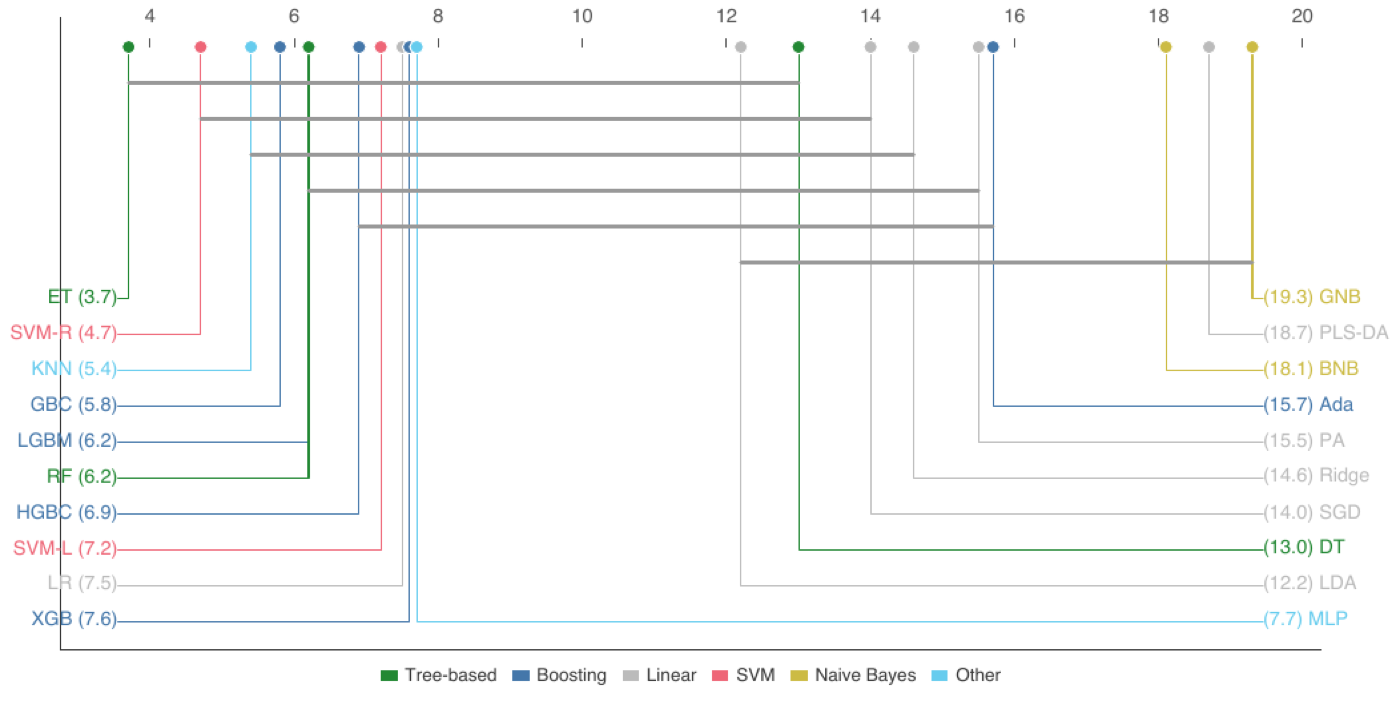
Tree-based machine-learning models outperform the published deep-learning Fruit-HSNet baseline at orders-of-magnitude lower compute cost, and just three visible-range wavelengths recover over 94% of full-spectrum accuracy. Low-cost multispectral sensors are a viable alternative to expensive hyperspectral cameras for practical fruit-quality sorting.
Method in brief
Twenty classical machine-learning algorithms are benchmarked on hyperspectral imaging data for joint ripeness classification and firmness prediction across five fruit species, using a cross-validated experimental design with Bayesian hyperparameter optimisation. Preprocessing strategy (class balancing, spectral transformation) is studied as an explicit factor alongside algorithm choice.
Key Contributions
- Systematic benchmark of 20 classical machine-learning algorithms on hyperspectral imaging data for joint ripeness classification and firmness prediction across five fruit species.
- Tree-based models match or outperform the state-of-the-art deep-learning Fruit-HSNet baseline at orders-of-magnitude lower compute cost and without GPU dependence.
- Demonstrates that preprocessing strategy (class balancing, spectral transformation) contributes as much to accuracy as model choice, with detailed ablations across the design space.
- Identifies that only three visible-range wavelengths recover over 94% of full-spectrum accuracy, showing that low-cost multispectral sensors are a practical alternative to expensive hyperspectral cameras.
Abstract
Post-harvest fruit quality assessment is essential for reducing food waste, yet reliable non-destructive methods typically depend on expensive hyperspectral cameras and computationally intensive deep learning models. These systems typically require GPU resources, large-scale training data, and domain expertise, limiting their feasibility for many real-world agricultural settings. This study systematically evaluates 20 classical machine learning algorithms on hyperspectral imaging data for simultaneous ripeness classification and firmness prediction across five fruit species, using cross-validated experimental design with Bayesian hyperparameter optimisation. Data preprocessing strategy, particularly class balancing and spectral transformations, contributes as much to prediction accuracy as algorithm choice. Our results show that tree-based machine learning models can outperform state-of-the-art deep learning models reported in Fruit-HSNet. Moreover, the findings indicate that only three visible-range wavelengths are needed to recover over 94% of full-spectrum accuracy, demonstrating that low-cost multispectral sensors combined with lightweight machine learning models can serve as practical alternatives to expensive hyperspectral cameras and complex deep learning approaches for practical fruit-quality sorting.