Identifiable Abstractions from Observation and Intervention
A Recursive Projection Bound for Created Minds
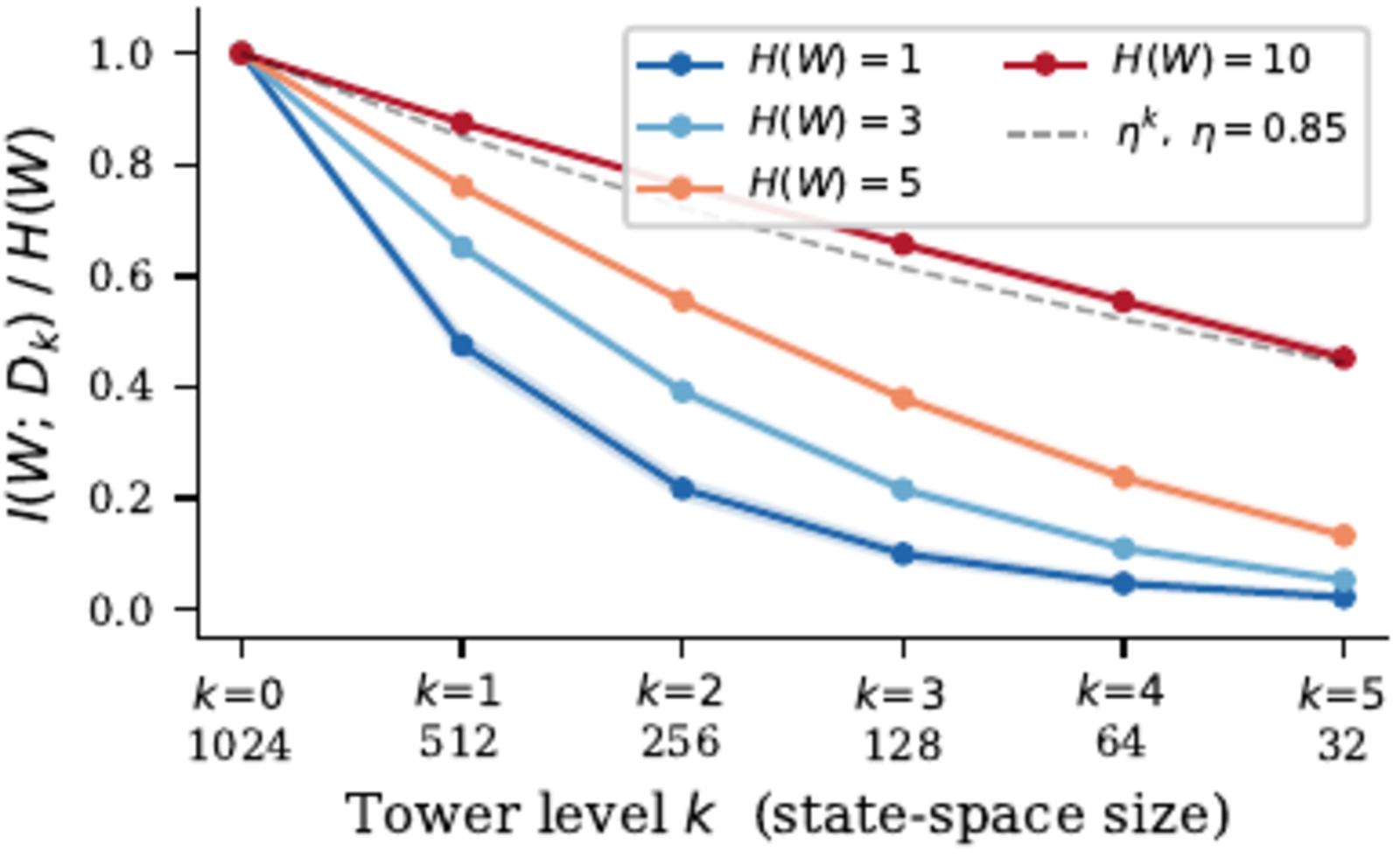
Headline result
A measurable query about a source variable is empirically identifiable if and only if it factors through the canonical experiment signature, equivalently the accessible sigma-algebra generated by the experiment family. Refinement is strict exactly when a new experiment splits a previously indistinguishable class. Deterministic creator-created towers are a special case, so origin-questions cannot be resolved from inside any fixed interface no matter how much one scales prediction within it.
Method in brief
Information-theoretic and measure-theoretic. The experiment family is treated as a collection of evidence-generating channels indexed by accessible policies. Identifiability of a query is reduced to factorization through the induced sigma-algebra. Controlled systems are decomposed into observational and interventional regimes; the deterministic tower of created minds is recovered as a corollary.
Key Contributions
- Defines a canonical experiment signature for an experiment family on a source variable, and proves that a measurable query is empirically identifiable if and only if it factors through that signature, equivalently through the accessible sigma-algebra generated by the experiments.
- Shows that enlarging the experiment family can only refine the induced abstraction, and that refinement is strict exactly when a new experiment splits a previously indistinguishable class.
- For controlled systems, separates observational identifiability (passive support) from interventional identifiability (probing inputs that distinguish passive classes), without invoking causal-graph assumptions.
- Treats deterministic creator-created towers as a special case: their epistemic limits arise from the abstraction induced by the interface, not from insufficient scale within a fixed interface. Companion paper to Every Mirror Has a Blind Spot, which is the internal-self dual.
Abstract
Observation and intervention rarely determine an upstream source uniquely. They determine only the queries that survive the available experiment family. We formalize this with a canonical experiment signature for an experiment family on a source variable S, and prove that a measurable query q(S) is identifiable if and only if it factors through that signature, equivalently through the accessible sigma-algebra generated by the experiments. Enlarging the experiment family can only refine the induced abstraction, and refinement is strict exactly when a new experiment splits a previously indistinguishable class. For controlled systems Y = h(X, U), passive observation identifies latent queries only up to agreement on the support of the observational regime, while interventions identify additional queries by probing inputs that distinguish those passive classes. Deterministic creator-created towers are a special case, so their epistemic limits arise from the abstraction induced by the interface rather than from insufficient scale within a fixed interface.